
WHAT REALLY DRIVES PARENT'S SCHOOL CHOICES?
Every year, parents in your area are making one of the biggest decisions of their child’s life — which school to choose.
And whether they realise it or not, they’re weighing up a mix of logic, gut feeling, and whatever information they can get their hands on.
So the question is: What really shapes those decisions — and what can your school do about it?
While there are lots of possible influences, the truth is that a few key factors consistently rise to the top.
What Might Parents Be Thinking About?
Here’s a quick overview of the full range of factors parents could be considering when choosing a school. Some will matter more than others, depending on the family:
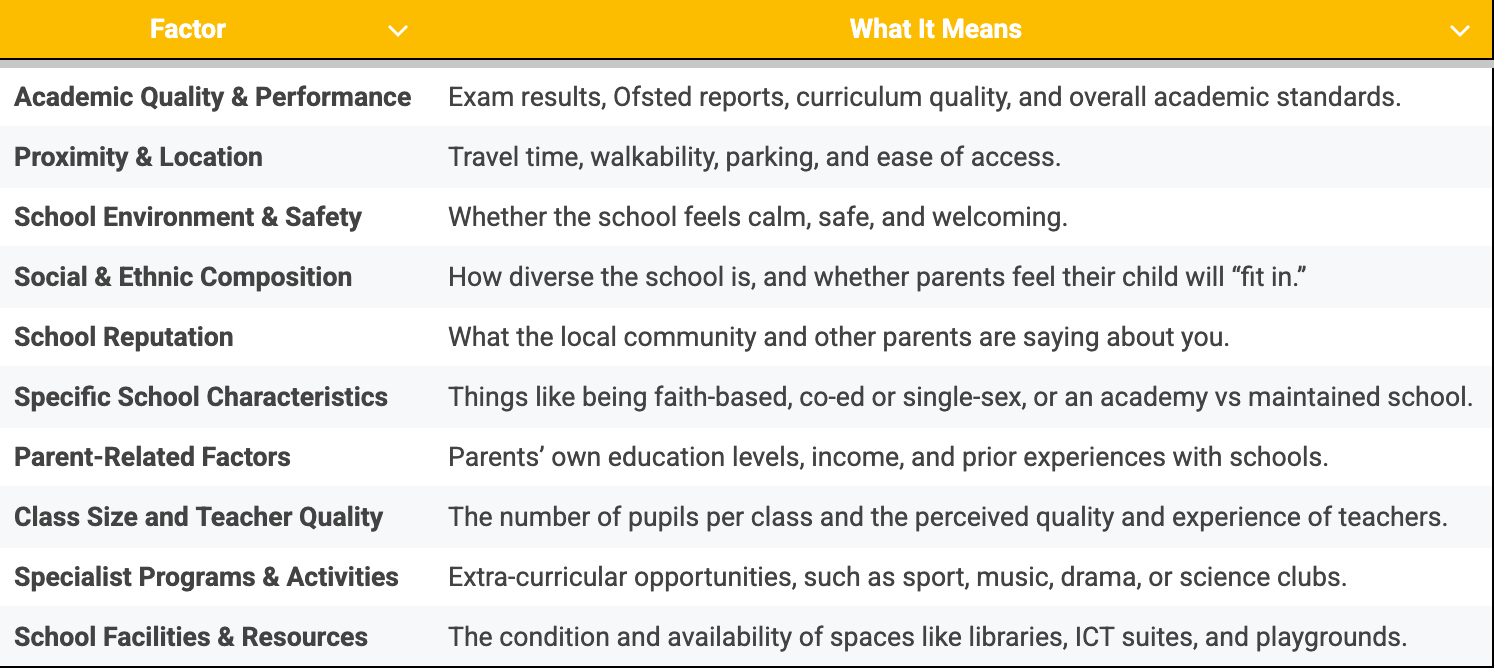
The Top 3 Factors That Really Influence School Choice
Now, here’s what the research — and real-world school experience — tells us are the three biggest factors driving decisions:
1. Academic Quality & Performance
This is consistently one of the first things parents look at. They want to know: Will my child do well here?
That could mean checking your SATs or GCSE results, scanning your Ofsted summary, or asking other parents what the teaching is like. But it’s not just about scores. Parents want reassurance that their child will be supported to succeed — whatever their starting point.
For example, I worked with a school that wasn’t topping the league tables, but they told brilliant stories about pupil progress — like the Year 4 child who jumped two reading levels in a term thanks to extra support. That kind of detail helped shift parents’ perception quickly.
Tip: In your marketing, don’t just mention outcomes — highlight the supportive journey you offer along the way.
2. Proximity & Location
It might sound obvious, but location plays a bigger role than many schools realise. Especially for busy families with younger children, a 15-minute walk versus a 15-minute drive can be the dealbreaker.
And yet, I often see school websites and flyers that barely mention where they are, or how easy it is to get there.
One school I worked with ran a Facebook ad targeted at local parents and saw a noticeable jump in attendance at their open day. Some parents said, “We didn’t even realise you were there!”
Tip: Don’t assume that every local parent is actively considering your school. Make the effort to engage with them. Showcase how easy it is for them to access your school – you might just surprise them with how convenient you are!
3. School Reputation
Reputation spreads fast — especially in WhatsApp groups, chats with friends, and on Facebook.
This isn’t always based on hard data. Often, it’s shaped by a single conversation or a shared story. The good news is, you can influence this by making it easier for your happy parents to speak up.
For instance, one school started sharing parent reviews on Facebook, where they shared short quotes from families about why they chose the school. It was simple, real, and powerful.
Tip: Actively shape your local reputation by sharing stories from your current families and staff.
Final thought:
You don’t need to address everything parents might be thinking about — but with limited time and resources, it helps to focus on the things that matter most.
Academic quality, convenience, and reputation consistently rise to the top. If you can communicate those well, you’re already ahead.

Ready to take the next step towards boosting your admissions?
Find out how the Standout School Marketing System can fill your open days and boost pupil numbers
References:
The conclusions drawn in this blog post are supported by the following research:
Academic Quality & Performance: Burgess, S., Greaves, E., & Vignoles, A. (2020). SCHOOL PLACES: A FAIR CHOICE? School choice, inequality and options for reform of school admissions in England. Sutton Trust. Rohde, N., Valente, M., & Wildhagen, T. (2019). Parental reasons for school choice in elementary school: A systematic review. Education Inquiry, 10(2), 203-221.
Proximity & Location: Burgess, S., Greaves, E., & Vignoles, A. (2020). SCHOOL PLACES: A FAIR CHOICE? School choice, inequality and options for reform of school admissions in England. Sutton Trust. Greaves, E. (2017). School Choice in England: Evidence from National Administrative Data. University of Bristol.
School Reputation: Woods, P. A., Bagley, C., & Glatter, R. (1998). School choice and competition: Markets in the public interest? Routledge.
Every year, parents in your area are making one of the biggest decisions of their child’s life — which school to choose.bAnd whether they realise it or not, they’re weighing up a mix of logic, gut feeling, and whatever information they can get their hands on.